The Chip That Said 'Hello World'
The Story of the First Integrated Circuit
“The only thing new in the world is the history you don’t know.” – Jack Kilby
We all know the names Jack Kilby and Robert Noyce, the giants of the semiconductor world. They're credited with inventing the integrated circuit (IC), the tiny brain of every modern gadget. But the story of how that first chip came to be is a fascinating tale of a forced summer of isolation, a little bit of luck, and a whole lot of genius. It's a story that laid the foundation for the complex world of Very-Large-Scale Integration (VLSI) that we know today.
A Summer of No-Vacation
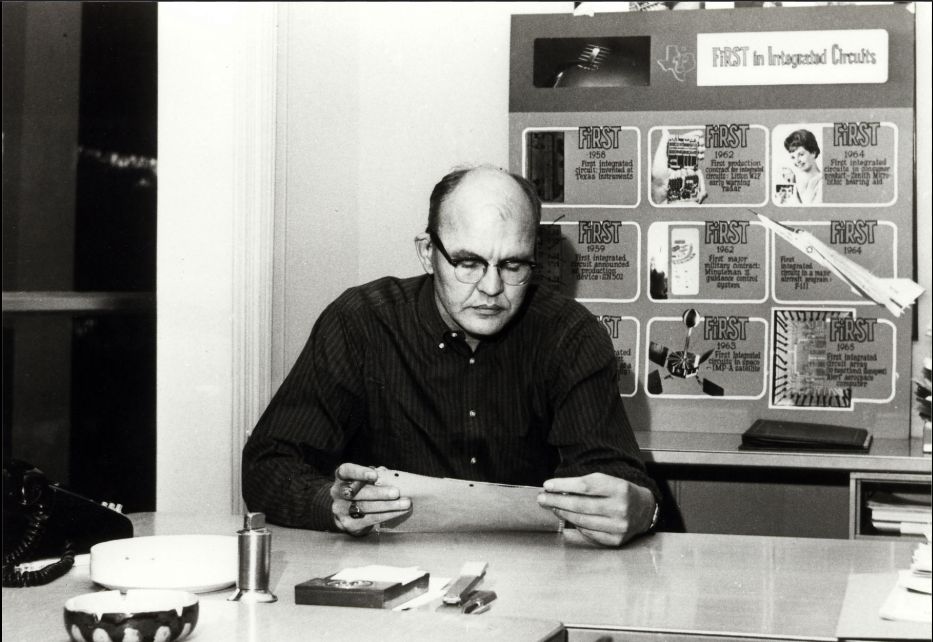
The year was 1958. Jack Kilby, a new engineer at Texas Instruments (TI), had a problem—his boss had a strict "no-vacation" policy. While his colleagues enjoyed their summer breaks, Kilby was left alone in the lab. This isolation, however, turned out to be a blessing in disguise. With time and space to think, he started to ponder a fundamental problem in electronics: the "tyranny of numbers." As circuits became more complex, they required more and more discrete components—transistors, resistors, capacitors—all of which had to be individually wired together.
The Eureka Moment: From Separate Parts to a Single Whole
Kilby's breakthrough was elegantly simple yet profoundly revolutionary. He realized that since all circuit components could be made from the same semiconductor material—silicon or, in his case, germanium—why not fabricate them all on a single piece of that material? This would eliminate the need for individual wiring, miniaturize the circuit, and make it more reliable.
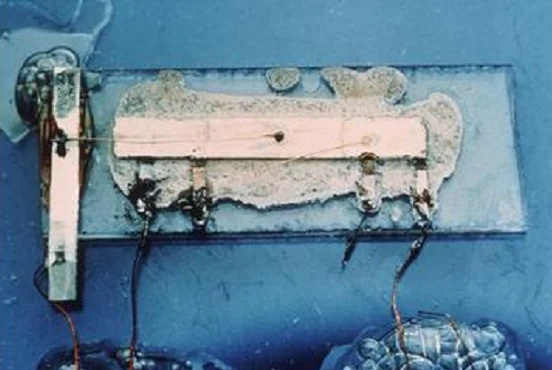
On September 12, 1958, Kilby demonstrated his creation: a small piece of germanium with a transistor and resistor integrated on it. He showed his boss that the circuit, a simple phase-shift oscillator, worked perfectly. This wasn't just a miniaturized circuit; it was the world's first integrated circuit.
💡 Did You Know?
Jack Kilby won the 2000 Nobel Prize in Physics for his invention of the IC—over 40 years after his summer project at TI!
From Kilby's Crude Chip to Modern VLSI
Kilby's initial IC was a crude, handmade device. The components were wired together with tiny gold wires, and the design was a far cry from the photolithography and etching processes used today. Yet, this simple chip was the first step on a journey that would lead to VLSI.
Modern VLSI chips contain billions of transistors. The principles Kilby pioneered—integration, miniaturization, and mass production—are the same ones that power our smartphones, laptops, and data centers today.
📜 Timeline of the Integrated Circuit
- 1958 – Jack Kilby demonstrates first working IC at TI
- 1959 – Robert Noyce (Fairchild) patents the planar IC
- 1961 – First commercial ICs released
- 1970s – ICs enable microprocessors & memory chips
- 1980s → Today – Rise of VLSI with billions of transistors
🌍 Legacy
From a lonely summer experiment to the foundation of the digital world, Kilby’s chip was the spark that lit the fire of modern computing. Every device you touch today traces its roots back to that little piece of germanium in 1958.